
Blood on the Fretboard: Sinners turns the blues into a bonfire

Ryan Coogler’s 1932 Mississippi vampire saga—shot in IMAX-scale grandeur, scored like a jukebox séance, and anchored by Michael B. Jordan in audacious dual roles—blends pulp and poetry into a midnight sermon you won’t soon forget.
There’s a wicked little theological joke at the heart of Sinners: if the preachers were right that the blues is the devil’s music, what happens when the devil shows up to dance? Writer‑director Ryan Coogler answers with a full‑throated, blood‑soaked reply—an operatic genre hybrid set in the Jim Crow South where juke-joint ecstasy collides with the oldest monster myth we’ve got. The film premiered in the U.S. on April 18, 2025, and, yes, it really is the one where Michael B. Jordan plays both of the “Smokestack Twins.” That logline sounds like a gimmick, but Sinners is committed—historically, musically, and cinematically—in ways that make even its showiest flourishes feel earned.
The hook: a juke joint, two brothers, and a hungry night
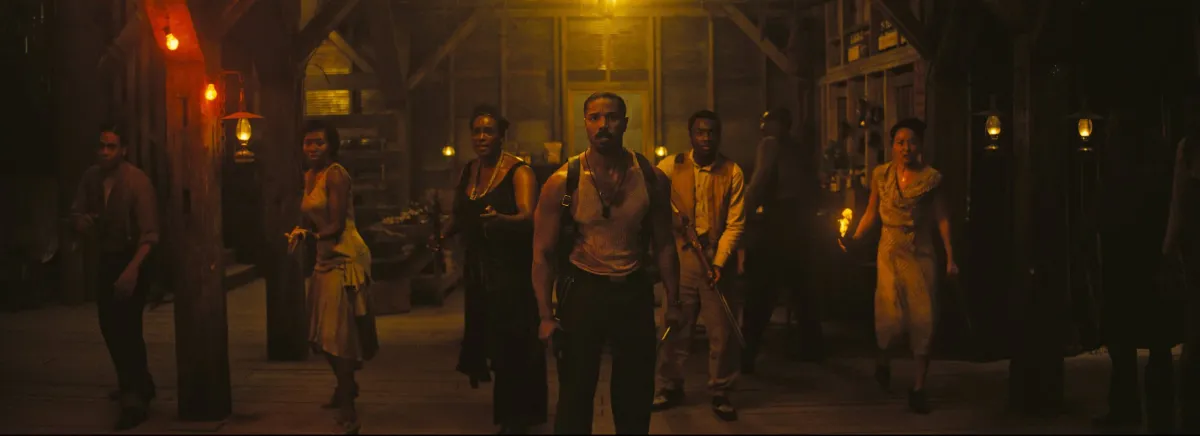
Set in 1932, the story follows Elijah “Smoke” and Elias “Stack” Moore (Jordan, in a canny, contrapuntal star turn), WWI vets who return to Clarksdale, Mississippi, intending to go straight by turning a sawmill into a juke for their community. Their cousin Sammie—“preacher boy” with a guitar and a gift—joins despite his pastor father’s warnings. The neighborhood hums. The music cooks. And then an outsider arrives: Remmick (Jack O’Connell), an Irish vampire with a smile like a razor and a taste for talent. When the twins won’t let him in, the night does what nights do in horror films: it opens its mouth. That’s the spoiler-light version, and it’s enough to say Sinners uses vampires as both literal threat and metaphor: cultural predators feasting on Black art and Black bodies, cloaked in the language of money and invitation.
The look: blues in colossal format
Coogler doesn’t just stage this as folklore; he engraves it onto celluloid at a scale usually reserved for capes and planets. Shot on IMAX film cameras (and Ultra Panavision 70) by Autumn Durald Arkapaw—the first woman to shoot a film on large‑format IMAX—the movie breathes in wide, humid frames where humidity seems to bead on your skin. The project’s roadshow allure even prompted a limited IMAX 70mm run (and a short re‑release in select IMAX 70mm venues May 15–21), a flex that doubles as a statement: this original, Black‑led, proudly weird studio movie belongs on the biggest screens we have.
Arkapaw lights the Delta like a memory you can walk around in—sultry reds, tarnished golds, and night skies black enough to swallow farmhands and fiends alike. Critics who quibbled with the film’s later swerve into monster‑movie mayhem still praised how it feels, which is to say: textured, sensuous, and alive. (NPR’s Justin Chang called it “so atmospheric… and gorgeous to watch” that the horror beats almost felt redundant.)
The sound: a needle drop that pierces the veil
If Sinners is a vampire picture, its other—and maybe truer—genre is “concert film of the soul.” Ludwig Göransson’s score doesn’t sit politely under scenes; it drags a chair to the center of the room. The sound world fuses Delta blues with hip‑hop, Irish folk, and church‑house call‑and‑response, culminating in a juke‑joint set‑piece where Sammie’s guitar seems to fold time: past and future apparitions swarm the dance floor; the roof literally catches fire; ecstasy and dread mingle until you can’t tell which is which. It’s as audacious on the page as it is on screen, and EW’s production breakdown confirms the sequence was built like a magic trick—IMAX cameras, VFX stitching, live DJing, and choreography choreographed to Göransson’s genre‑collapsing track list.
Göransson has said he wrote much of the score using a period‑appropriate 1932 Dobro resonator—the same kind of guitar Sammie carries—so the film’s music isn’t merely evocative; it’s materially rooted in the era the movie is haunting. The result is a film that doesn’t just reference the blues; it argues that music is a technology for speaking with the dead.
The players: dual Jordans, a rising star, and an icon walks in
Jordan differentiates Smoke and Stack with the kind of clear bodywork you notice before you clock the VFX: Smoke leads with the jaw; Stack, with the eyes. Around him, Wunmi Mosaku grounds the film as Annie, a Hoodoo‑wise wife whose belief in protection magic becomes a survival manual; Delroy Lindo brings wheezy gravitas as Delta Slim; and Hailee Steinfeld invests Stack’s ex Mary with a hungry ambivalence the story needs. Newcomer Miles Caton is the discovery—his Sammie has the wariness of a kid raised on Bible verses and the posture of someone who’s not sure if playing guitar is a sin or a calling. And then, in an end‑credits grace note that reframes what we’ve seen, blues legend Buddy Guy turns up as an elder Sammie—an Easter egg that lands like benediction. (Guy has discussed why he said yes: to “help the blues.”)
O’Connell’s Remmick is worth a paragraph of his own: neither cape‑swishing aristocrat nor feral ghoul, he’s a salesman of immortality who treats music like a resource to be extracted—Silicon Valley pitch deck by way of coffin. When he sidles up to the juke door with cash and compliments, the film’s allegory clicks: exploitation can arrive with good manners.
The scene everyone talks about—and the scene no one forgets
The juke night is the obvious showstopper, but the coda is the movie’s soul. In a late‑in‑life encounter, Sammie meets immortality face to face and chooses the mortal thing: a song, a memory, and the promise that art—played by human hands in human time—might be enough. Coogler has said that the post‑credits moment is the key to the entire film, a personal tribute to a beloved uncle and to the Delta’s musical lineage. It’s a quietly radical way to end a studio horror picture: not with a sequel tease (though the door is cracked), but with acceptance.
What it’s about (besides vampires)
Plenty of films make metaphor of monsters; Sinners makes metaphor of the juke joint itself—one room where a community can be fully alive under conditions designed to diminish it. The movie stages a pitched battle between austerity and appetite, between a church that warns against “devil’s music” and a Hoodoo practice that insists on protection through practice, not prohibition. The Klan lurks at the margins—not as twist villains but as the banal political scaffolding that lets the supernatural parasite flourish. Coogler’s point isn’t that the blues summons evil; it’s that the blues is how you endure it.
When the sermon gets noisy
The fair critique (echoed by several top‑shelf reviewers) is that Sinners is “messy”—its third act zigzags through tones and genres, and some late‑night vampire‑hive logic hand‑waving won’t satisfy every lore nerd. For some, the pivot from lived‑in period drama to supernaturally maximalist showdown will read like a comedown from the intoxicating first half. Yet even detractors tend to concede that the images sing and the ambition is thrilling—“glorious,” as Rolling Stone’s A.A. Dowd put it, in its willingness to swing beyond franchise guardrails. And the Guardian’s Wendy Ide captured the paradox neatly: pick at the threads and you’ll find knots, but Coogler’s assurance holds the tapestry together.
The craft: production choices that matter
A quick craft flex is in order. The choice to shoot on large‑format film isn’t just cosmetics: it scales up faces and bodies, granting mythic stature to people the dominant culture tried to make small. That philosophy extended to distribution, where the studio supported special IMAX 70mm engagements and even brought the film back for a limited re‑release due to demand. Arkapaw has spoken about treating IMAX not as a gimmick but as a way to feel the Delta’s magnitude—and audiences responded in the only language that matters to the suits: ticket sales.
Even more heartening: Warner Bros. helped deliver the movie to the community it depicts. Because Clarksdale lacks a working cinema, the team hosted multiple screenings and conversations at the civic auditorium at the end of May; Coogler and collaborators showed up in person. Sometimes a “four‑quadrant” win looks like an auditorium full of neighbors cheering for a story that takes their history seriously.
The numbers (and why they matter)
Originals don’t often punch this hard. Sinners opened stateside around $48 million, then posted an eye‑rubbing ~5% second‑weekend dip—one of the best holds on record for a wide‑release R‑rated horror film—on its way to $366.7 million worldwide. The domestic haul alone sits near $279 million. These are unicorn figures for a non‑IP horror hybrid with thorny politics and a blues‑first heart, and they reframed a media narrative that initially obsessed over Coogler’s unusual deal terms (first‑dollar gross, final cut, and 25‑year reversion). The audience showed up; the movie traveled; the ink on the negotiation theory pieces is already fading.
Performances worth savoring
- Michael B. Jordan, doubled: The VFX stitching is seamless, but it’s the actorly differentiation that sells it. One brother is a pragmatist, the other a romantic; you can feel Jordan playing arguments with himself without once resorting to shtick.
- Miles Caton, arriving: The role asks for piety, hunger, and stage charisma; Caton checks every box, and his own musical chops let Coogler and Göransson fuse diegetic performance with score in ways that cheat neither. GQ’s profile hints at why Sammie lingers: he’s a kid choosing art over fear in a world designed to make fear feel righteous.
- Wunmi Mosaku & Delroy Lindo: Mosaku turns pragmatism into heroism; Lindo brings the ache of a legend who knows music can save your soul and still get you killed.
- Hailee Steinfeld & Jack O’Connell: Steinfeld’s Mary isn’t simply temptation; she’s a person shrewd about the deal on the table. O’Connell, meanwhile, plays exploitation as charm.
- Buddy Guy, benediction: Sometimes stunt casting becomes story. Here it feels inevitable.
Verdict: a pulpy, beautiful howl
Sinners is not the tidy, four‑quadrant vampire flick some marketing copy might have promised—it’s better. It’s a brash studio epic that treats Black music as cosmology, uses genre to pry open old wounds, and underlines a notion the blues has preached for a century: joy is a survival strategy. If the last reel gets unruly, that unruliness is part of the film’s argument. Coogler isn’t just staging good vs. evil; he’s staging appetite vs. austerity, life vs. control. On those terms, the movie wins.
See it how you can—but see it big if possible. And then, like the best records, play it again and hear what you missed the first time.
How to watch
After its theatrical run (including special IMAX 70mm engagements), Sinners became available digitally in early June and later hit streaming; if you missed the roadshow, the home version still showcases the film’s shifting aspect ratios and thunderous mix.